
Contact Us

close


Lidl overtaking Morrisons to become Great Britain's fifth-largest supermarket was more than a change in the grocery rankings.
It was a clear signal of how comfortable shoppers have become with moving their spend when value feels stronger elsewhere.
That should make branded suppliers look harder at one of retail's most familiar marketing tools: sampling.
Not because sampling is new.
Quite the opposite. It's been around for so long that the industry can sometimes treat it like the easy bit.
Put product in hand.
Drive trial.
Count the contacts.
Move on.
And that's the problem.
Sampling has a perception issue.
It is still too often seen as a giveaway mechanic, sitting somewhere between tactical activation and nice-to-have support. Useful, but not always strategic. Easy to understand, but easy to undervalue.
In the current grocery market, that view is starting to look commercially expensive.
Worldpanel by Numerator figures for the 12 weeks to 17 May 2026 showed Lidl reaching an 8.6% market share, helped by 8.8% year-on-year sales growth.
The same period saw promoted-item spend rise 9.5% year on year, while full-price spend barely moved.
Reward's 2025 grocery data tells a similar story from the shopper's side. It found that 41% of UK consumers had moved away from their primary grocer, while 80% bought from two or more grocers in June.
EY's Future Consumer Index also found that value is now twice as important as brand in UK purchase decisions, with 42% of consumers switching to own-brand or cheaper alternatives.
The signal is clear enough.
Shoppers are willing to switch.
But that doesn't mean they're willing to take a punt.
And that distinction matters.
A shopper choosing a cheaper alternative is not always rejecting the brand.
They may simply be reducing risk.
A parent buying the same lunchbox snack every week isn't necessarily loyal in any deep emotional sense; they may just know it gets eaten.
A household sticking with the same sauce, cereal, drink or frozen product may not be closed to something new.
They may only need enough proof that the new choice will earn its place.
This is where sampling should be doing more work.
The issue isn't whether sampling can drive trial.
Of course it can.
The more useful question is whether it's being designed to reduce uncertainty, which is now one of the biggest barriers to switching.
When money is tighter, a failed purchase feels more wasteful.
When choice is wider, decision-making requires more effort.
When retailers are pushing value, own-label and loyalty pricing harder, branded products need to justify themselves quickly and clearly.
A free taste can open the door.
But it rarely closes the argument on its own.
That's why sampling needs to be understood as product proof.
Product proof does more than put something in someone's hand.
It helps shoppers understand why the product matters, how it fits into their lives, and why it's worth choosing over the option they already know.
For a new snack, that might mean showing how it works in a lunchbox, not just that it tastes good.
For a chilled product, it might mean helping shoppers picture the meal occasion.
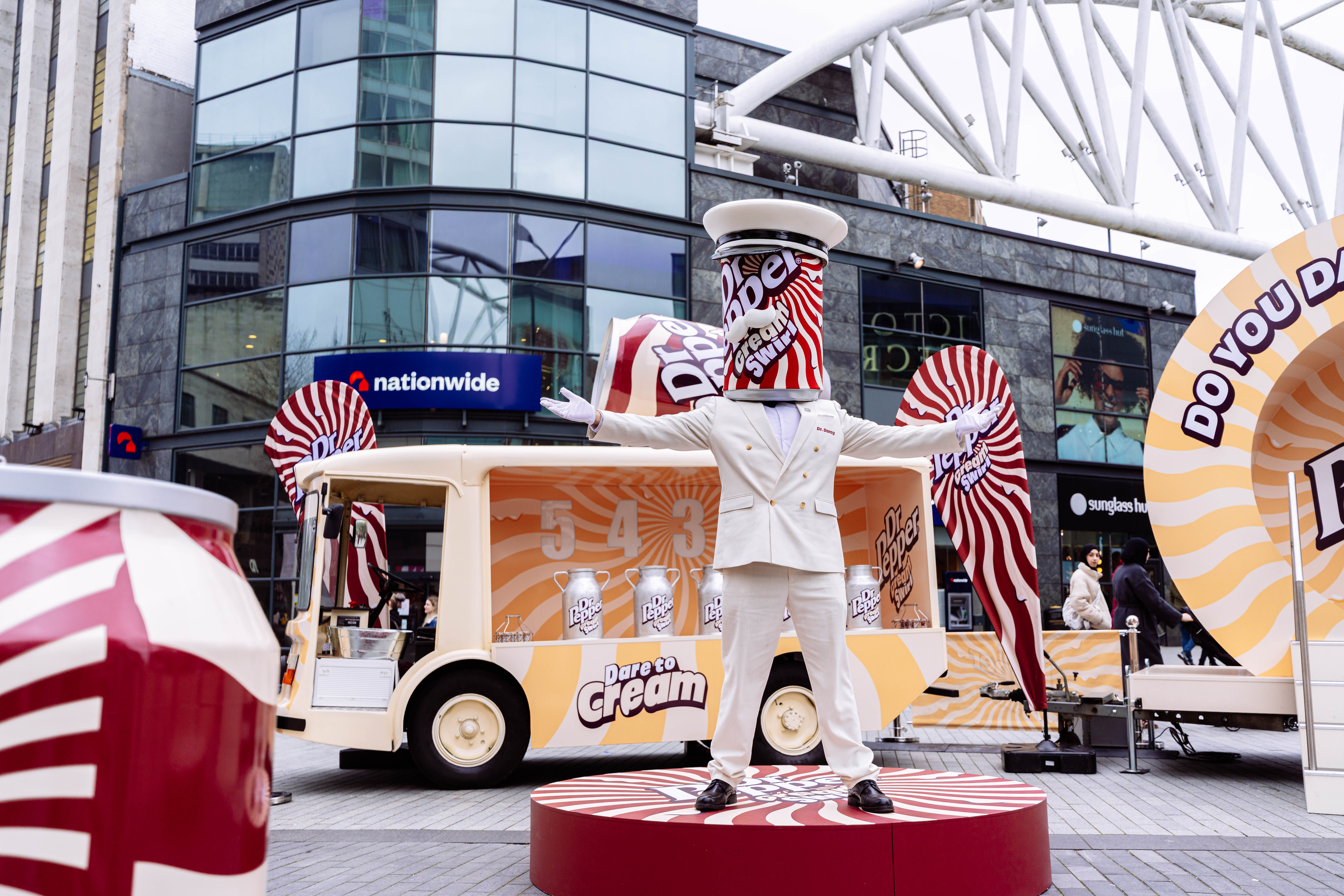
For a premium soft drink, it might mean proving the serve, the quality cue, and the reason to trade up.
For a health or functional product, it might mean explaining the benefit in plain language at the exact moment shoppers are weighing up the shelf.
The sample is the proof point.
The experience around it is what turns proof into confidence.
And that's an important distinction for brands, because grocery shoppers aren't short of messages — they're short of certainty.
Tesco Media's We Know the Nation 2026 report found that 71% of shoppers like discovering new brands while shopping.
That should encourage suppliers.
Stores are still powerful places for discovery, especially when people are already in decision mode.
But discovery doesn't automatically lead to purchase.
Interest needs a bridge.
Sampling can be that bridge when it's planned with more ambition than simply "try this."
The best programmes start with the barrier, not the product.
What does the shopper need to believe before they switch?
Is the concern:
Is the right moment in-store, at home, online, through retail media, through a Brand Ambassador, or through a connected combination of these?
Once that barrier is clear, sampling becomes a much sharper commercial tool.
It can reassure.
It can educate.
It can make a new product feel familiar enough to buy.
It can turn a promotion into a more persuasive value story.
It can help brands defend against own-label pressure by proving the difference rather than simply claiming it.
That's where the industry needs to raise its expectations.
Too often, sampling is measured by immediate outputs:
Those metrics matter.
But they aren't the full picture.
If the commercial challenge is switching, measurement needs to get closer to behaviour.
Questions brands should be asking include:
Sampling shouldn't be treated as the softest part of the plan simply because it's physical, familiar and easy to understand.
Brands need to earn every switch.
Sampling should be recognised as one of the sharpest commercial tools available.
The grocery market is giving branded suppliers a very clear message.
Shoppers are moving.
And they're comparing harder.
They're open to change when the value equation makes sense.
That creates an opportunity — but only for brands that give people enough confidence to choose differently.
Sampling doesn't need a new name.
It needs a better reputation inside the marketing plan.

Authored By:
Lorem ipsum dolor sit amet, consectetur adipiscing elit. Suspendisse varius enim in eros elementum tristique. Duis cursus, mi quis viverra ornare, eros dolor interdum nulla, ut commodo diam libero vitae erat. Aenean faucibus nibh et justo cursus id rutrum lorem imperdiet. Nunc ut sem vitae risus tristique posuere.
Lorem ipsum dolor sit amet, consectetur adipiscing elit. Suspendisse varius enim in eros elementum tristique. Duis cursus, mi quis viverra ornare, eros dolor interdum nulla, ut commodo diam libero vitae erat. Aenean faucibus nibh et justo cursus id rutrum lorem imperdiet. Nunc ut sem vitae risus tristique posuere.
Published:
Lorem ipsum dolor sit amet, consectetur adipiscing elit. Suspendisse varius enim in eros elementum tristique. Duis cursus, mi quis viverra ornare, eros dolor interdum nulla, ut commodo diam libero vitae erat. Aenean faucibus nibh et justo cursus id rutrum lorem imperdiet. Nunc ut sem vitae risus tristique posuere.
Lorem ipsum dolor sit amet, consectetur adipiscing elit, sed do eiusmod tempor incididunt ut labore et dolore magna aliqua. Ut enim ad minim veniam, quis nostrud exercitation ullamco laboris nisi ut aliquip ex ea commodo consequat. Duis aute irure dolor in reprehenderit in voluptate velit esse cillum dolore eu fugiat nulla pariatur.
Block quote
Ordered list
Unordered list
Bold text
Emphasis
Superscript
Subscript

.png)
.png)
.png)
.png)
.png)
.png)
.png)
.png)
.png)
.png)

















.jpg)


.jpg)